Introduction
Art has always evolved alongside technological change. From the invention of photography to the emergence of digital illustration, new tools have continuously expanded the possibilities of creative expression. Today, algorithms, artificial intelligence, and computational design are reshaping how artists imagine, produce, and share their work. In this changing landscape, the canvas is no longer limited to a physical surface. It can exist as a digital interface, a generative image, an interactive installation, or a continuously evolving visual environment.
The algorithmic age raises important questions about creativity, originality, and the relationship between humans and machines. While technology introduces new methods of artistic production, it also encourages a renewed appreciation for the intention, emotion, and personal perspective that give art its meaning.
The Evolution of the Canvas
Traditionally, the canvas has represented a space where artists translate ideas into visible forms through paint, pigment, and physical gestures. Its surface preserves the marks of the creative process, allowing viewers to encounter the artist’s decisions and techniques.
Digital technology has expanded this concept considerably. Artists can now work with tablets, computer software, three-dimensional environments, and interactive displays. These tools make it possible to experiment with layers, textures, lighting, and compositions that would be difficult to achieve through traditional methods alone.
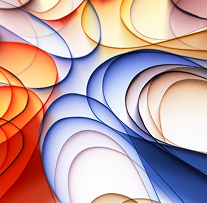
In algorithmic art, the canvas may also become a system governed by rules. Artists create instructions that determine how shapes, colors, lines, or patterns develop. The final image may emerge through calculations, random variables, or responses to external information.
This approach transforms the creative process. Instead of determining every visual detail, the artist establishes a framework within which unexpected outcomes can occur.
Understanding Algorithmic Art
Algorithmic art uses computational procedures to generate or influence artistic compositions. These procedures may involve mathematical formulas, programmed instructions, artificial intelligence, or data-driven systems.
Some artists use simple rules to produce intricate geometric patterns. Others create complex visual environments that change according to sound, movement, weather, or information collected from the surrounding world.
The appeal of algorithmic art lies partly in its ability to combine structure with unpredictability. A carefully designed system can generate countless variations, each displaying relationships between form, repetition, and change.
However, algorithms do not eliminate the artist’s role. Human decisions remain important in selecting the underlying rules, choosing the materials, defining the visual objectives, and deciding which results deserve further development.
The computer becomes a creative instrument rather than an automatic replacement for artistic judgment.
Artificial Intelligence and Creative Collaboration
Artificial intelligence has introduced another dimension to digital art. Generative systems can produce images, suggest compositions, explore visual styles, and transform written descriptions into complex imagery.
For artists, these capabilities can accelerate experimentation. A concept that once required extensive preliminary sketching can be explored through multiple digital variations. Artists may then refine selected results, combine them with original drawings, or use them as starting points for more extensive projects.
Yet AI-generated imagery also raises questions about authorship, training data, copyright, and originality. When a system learns patterns from existing images, discussions emerge about the rights and contributions of the artists whose work helped shape its output.
These concerns highlight the importance of transparency and responsible creative practice. Artists, developers, and institutions must consider how digital tools are trained, how generated works are presented, and whether the use of particular materials respects applicable rights.
Ultimately, technological capability alone does not determine artistic value. Context, intention, interpretation, and the choices made throughout the creative process remain significant.
The Human Element Behind Digital Creation
Despite increasing automation, human experience continues to shape meaningful artistic expression. Emotions, memories, cultural backgrounds, and personal observations influence the ideas artists choose to explore.
An algorithm can generate thousands of visual arrangements, but an artist must still determine what those arrangements communicate and why they matter. A seemingly simple digital composition may reflect personal grief, environmental concerns, social change, or an investigation into identity.
Human involvement also extends to the experience of the audience. Viewers interpret images through their own memories and perspectives, creating meanings that may differ from the artist’s original intentions.
This relationship demonstrates that art is more than the production of an image. It involves communication between creators, materials, technologies, and audiences.
The algorithmic age therefore does not necessarily diminish human creativity. Instead, it challenges artists to reconsider where creative decisions occur and how artistic meaning develops.
Challenges of Art in an Automated World
The growing accessibility of digital tools has created new opportunities for participation, but it has also introduced challenges.
The enormous volume of AI-generated imagery can make it difficult for individual artists to gain visibility. Online platforms often prioritize content according to engagement metrics, recommendation systems, and commercial objectives. As a result, artistic discovery may depend partly on algorithms that do not necessarily recognize originality or cultural significance.
There is also a risk that automated production could encourage visual uniformity. When many creators rely on similar tools and popular styles, images may begin to share recognizable patterns and aesthetics.
Maintaining a distinctive artistic voice therefore becomes increasingly important. Experimentation, critical thinking, personal observation, and thoughtful engagement with materials can help artists develop work that goes beyond familiar digital formulas.
Education also has a role to play. Understanding both traditional artistic principles and emerging technologies allows creators to make informed decisions rather than treating automation as an unquestioned solution.
The Future of the Digital Canvas
The future of art will likely involve continued interaction between traditional craftsmanship and computational methods. Physical paintings may incorporate digital projections, while virtual environments may respond to viewers in real time. Artists could combine hand-drawn elements with generated imagery, creating works that move between material and digital spaces.
These developments will expand the possibilities of artistic experimentation while making questions of authorship and responsibility even more important.
Rather than replacing the traditional canvas, algorithmic tools offer additional ways to explore it. The essential challenge will be to use technology in ways that support meaningful expression rather than allowing novelty to become the primary objective.
Conclusion
Canvas in the algorithmic age represents a transformation in how art is created, experienced, and understood. Through computational systems and artificial intelligence, artists can explore new visual languages, experiment with complex patterns, and develop interactive forms of expression.
Yet the foundations of artistic practice remain relevant. Intention, interpretation, imagination, and cultural understanding continue to influence how creative work acquires meaning.
The modern canvas may exist on a screen, within an algorithm, or across an interactive environment, but its purpose remains familiar: to provide a space where ideas become visible and invite reflection.
In the end, the most compelling art of the algorithmic age will not necessarily be the work produced by the most advanced technology. It will be the work in which technology and human imagination come together to communicate something meaningful.