Introduction
Light has always played an essential role in how people experience art, architecture, and the world around them. Beyond simply illuminating a space, light can influence emotions, shape perceptions, and transform ordinary environments into extraordinary experiences. When combined with immersive design, it becomes a powerful artistic medium that invites viewers to move beyond observation and become active participants in their surroundings.
From luminous installations in contemporary galleries to carefully illuminated architectural spaces, the relationship between immersion and light continues to redefine how audiences connect with visual environments. By combining illumination, movement, color, and spatial design, artists create experiences that engage the senses and encourage deeper emotional connections.
The Relationship Between Light and Immersion
Immersion occurs when an environment captures a person’s attention so completely that the surrounding experience becomes the primary focus. In art and design, this can be achieved through carefully coordinated visual elements that surround viewers and encourage them to explore a space.
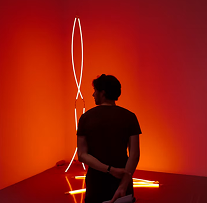
Light is particularly effective in creating immersion because it influences how people perceive depth, distance, and movement. A softly illuminated room may feel peaceful and intimate, while a space filled with shifting beams and dramatic contrasts can produce excitement or uncertainty.
Unlike traditional paintings displayed within fixed frames, immersive light installations often extend across walls, ceilings, and floors. This creates a sense of continuity between the artwork and its surroundings. Visitors are no longer simply looking at an image; they are standing within an environment that changes their perception of space.
Through this approach, light becomes both the subject of the artwork and the medium through which the experience unfolds.
How Light Shapes Emotional Experiences
One of the most remarkable qualities of light is its ability to influence mood. Warm illumination often creates feelings of comfort, familiarity, and relaxation. Cooler lighting can suggest distance, stillness, or a futuristic atmosphere. Meanwhile, dramatic shifts between brightness and darkness introduce tension and visual excitement.
Artists use these effects to guide emotional responses without relying on words or recognizable objects. A slowly changing glow can encourage contemplation, while rapidly moving patterns may create a sense of energy and movement.
The intensity of illumination also matters. Soft, diffused light can make an environment feel open and welcoming, whereas concentrated beams create distinct focal points and emphasize specific architectural features.
These effects are especially powerful when viewers can move freely through an installation. As their positions change, shadows shift, reflections appear, and the artwork reveals new visual relationships. Each person may therefore experience the same environment differently.
Architecture as a Canvas for Light
Architecture provides an ideal foundation for immersive light experiences. Walls, ceilings, columns, staircases, and open spaces offer surfaces onto which light can be projected, reflected, or diffused.
In contemporary exhibitions, projections can transform plain architectural surfaces into animated landscapes. A stationary wall might appear to dissolve into flowing water, shifting geometric patterns, or abstract fields of color. Through carefully designed illumination, familiar structures acquire new identities.
Natural light also contributes to immersive architectural experiences. Sunlight entering through large windows or narrow openings creates changing patterns throughout the day. These variations establish a connection between interior spaces and the passage of time.
Architects increasingly consider lighting as an essential component of spatial design rather than a purely functional requirement. By coordinating natural illumination, artificial light, and material surfaces, they can create environments that respond to human movement and changing atmospheric conditions.
Technology and the Evolution of Immersive Art
Advances in digital technology have expanded the possibilities for light-based installations. High-resolution projectors, programmable LED systems, motion sensors, and interactive software allow artists to create environments that respond dynamically to their audiences.
Interactive installations may change color when visitors approach, generate patterns in response to movement, or alter their visual compositions according to sound. These features establish a relationship between the artwork and its audience, making participation an important part of the experience.
Digital mapping technology also allows projected imagery to follow the contours of complex architectural structures. This technique can make buildings appear to move, transform, or reveal imaginary dimensions.
However, technology alone does not guarantee a meaningful immersive experience. The strongest installations use technical innovation to support a clear artistic idea. Thoughtful pacing, spatial organization, and visual restraint often create a more lasting impression than constant movement or overwhelming brightness.
The Role of Darkness and Negative Space
Although immersion and light may appear inseparable from brightness, darkness is equally important. Without areas of shadow, illuminated elements lose much of their visual impact.
Darkness provides contrast, directs attention, and creates room for anticipation. In a dim gallery, a single illuminated object may appear more significant because the surrounding environment allows viewers to focus without distraction.
Negative space also influences how people move through immersive environments. Unlit areas can create pauses between visual experiences, encouraging visitors to reflect on what they have already encountered.
By balancing illumination with darkness, artists establish rhythm and atmosphere. This balance prevents sensory overload and allows individual moments to develop their own emotional significance.
Conclusion
The relationship between immersion and light demonstrates how artistic experiences can extend beyond traditional visual boundaries. Through illumination, shadow, spatial design, and interactive technology, artists transform environments into places that encourage exploration and emotional engagement.
Light shapes what viewers see, while immersion influences how they experience it. Together, these elements create opportunities to reconsider familiar spaces, discover new perspectives, and connect with art in more personal ways.
Ultimately, the power of immersive light lies not simply in its ability to transform a room, but in its capacity to transform the way people perceive and remember the spaces they inhabit.